
The "U" is Back: Miami Edges Ole Miss in Fiesta Bowl Thriller to Secure CFP National Championship Berth
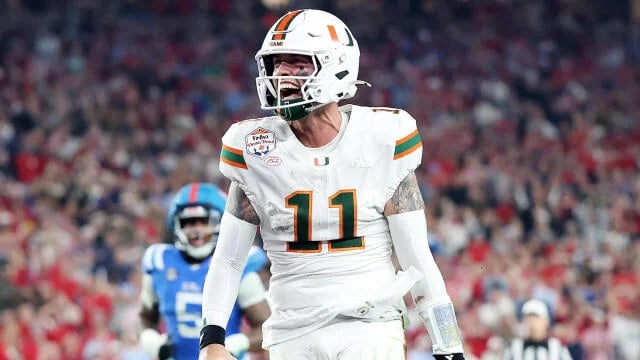
In a classic back-and-forth battle at State Farm Stadium, the Miami Hurricanes clinched a 31-27 victory over the Ole Miss Rebels to advance to the College Football Playoff National Championship.
SPORTS
Muhammad Umaish
1/9/20263 min read
Miami Returns to Glory: Hurricanes Edge Ole Miss in Fiesta Bowl Classic to Reach National Championship
The Miami Hurricanes are headed to the College Football Playoff National Championship Game after emerging victorious in a 31-27 defensive and offensive seesaw against the Ole Miss Rebels.1 In a game defined by grit, late-game heroics, and a controversial finish at State Farm Stadium, the Hurricanes proved they have the fortitude to return to the pinnacle of college football. The win sets up a title bout against either Oregon or Indiana, marking Miami’s first shot at a national crown since their heart-wrenching double-overtime loss to Ohio State over two decades ago.
A Fourth Quarter for the Ages
The Fiesta Bowl lived up to its reputation as a theater for the dramatic. While the first three quarters provided plenty of highlights—including a blistering 73-yard touchdown run by Ole Miss’s Henry Lacy and a 52-yard scoring strike from Carson Beck to Keelan Marion—the final fifteen minutes transformed the game into an instant classic.
The lead changed hands four times in the fourth quarter alone. After Trinidad Chambliss orchestrated a drive that put the Rebels up 19-17, Miami responded immediately. Malachi Toney turned a short screen pass into a 36-yard touchdown, regaining the lead for the Hurricanes. However, the Rebels, led by first-year head coach Pete Golding, refused to fold. Chambliss found tight end Dae’Quan Wright for a 24-yard touchdown, followed by a successful two-point conversion to Caleb Odom, giving Ole Miss a 27-24 advantage with only five minutes remaining.
With their season on the line, Carson Beck took control. Orchestrating a methodical drive, Beck utilized Keelan Marion to move deep into Rebels territory. Eschewing the safe play for a game-tying field goal, Beck spotted a gap in the defense and scrambled 3 yards into the end zone with just 18 seconds on the clock, sealing the 31-27 victory.2
Statistical Standouts
The box score reflected a game played at an elite level by both sides. Miami’s Carson Beck finished 23-of-37 for 268 yards and two passing touchdowns to go along with his game-winning rush.3 The Hurricanes' ground game was equally vital, churning out 191 yards. Mark Fletcher Jr. was the workhorse, recording 133 yards on 22 carries, providing the physical presence Miami needed to wear down the Rebels' front.
For Ole Miss, Trinidad Chambliss proved he belonged on the big stage despite his Division II roots. He matched Beck’s completions exactly, going 23-of-37 for 277 yards. His primary targets, De’Zhaun Stribling and Dae’Quan Wright, combined for over 140 yards, while Lacy’s explosive rushing kept the Hurricanes' defense on its heels for much of the afternoon.
Controversy and the "SEC Problem"
As the clock ticked toward zero, the game ended on a note that will likely be debated in Oxford for years. On a final "Hail Mary" heave from Chambliss, the ball grazed the hand of Stribling before hitting the turf. However, replays indicated significant contact from Miami defensive back Ethan O’Connor, who appeared to be grabbing Stribling’s jersey as the ball arrived. No flag was thrown, evoking memories of the 2003 Fiesta Bowl, where a late pass interference call famously went against Miami. This time, the silence of the whistles worked in the Hurricanes' favor.
The loss serves as a sobering moment for the Southeastern Conference. For the third consecutive year, the SEC will be absent from the national championship game. Despite Ole Miss’s valiant effort, the conference finished the bowl season with a lackluster 2-7 record. Even Paul Finebaum, often the league's most vocal supporter, admitted that the conference’s recent postseason struggles are becoming impossible to defend. The "SEC dominance" narrative has hit a significant roadblock, with the power center of college football shifting toward the Big Ten and a resurgent Miami program.
Historical Resonance and the Road Ahead
Miami’s victory is steeped in historical irony. Their return to the national championship comes 23 years after their dynasty was derailed in this very stadium. Head coach Mario Cristobal, a Miami alumnus who won two national titles as a player for the Hurricanes, has finally steered his alma mater back to the stage where he once excelled.
The Hurricanes now await the winner of the Oregon vs. Indiana semifinal. Both potential matchups offer fascinating storylines:
• The Cristobal Connection: If Miami faces Oregon, Cristobal will be coaching against the program he led to two Pac-12 titles.
• The High School Reunion: If Miami faces Indiana, the game will feature a unique "Christopher Columbus High" connection. Both Cristobal and Indiana’s star quarterback, Fernando Mendoza, graduated from the same Miami private school.
Regardless of the opponent, Miami will face a team looking to make history, as neither the Ducks nor the Hoosiers has ever won a football national championship.
Conclusion
The Hurricanes' 31-27 win over Ole Miss was more than just a victory; it was a statement of resilience. From Carson Beck’s poise under pressure to a defense that held firm when it mattered most, Miami has proven it is ready for the ultimate spotlight. While the Rebels head home after a "magical run" that defied expectations, the Hurricanes are one win away from reclaiming their status as the kings of college football.