
Spielberg’s ‘Disclosure Day’: Cinematic Masterpiece or Secret Message to Mankind?
Steven Spielberg’s upcoming sci-fi epic, Disclosure Day, has moved beyond the realm of cinema to spark a global firestorm of conspiracy theories.
MOVIES
Muhammad Umaish
12/17/20253 min read
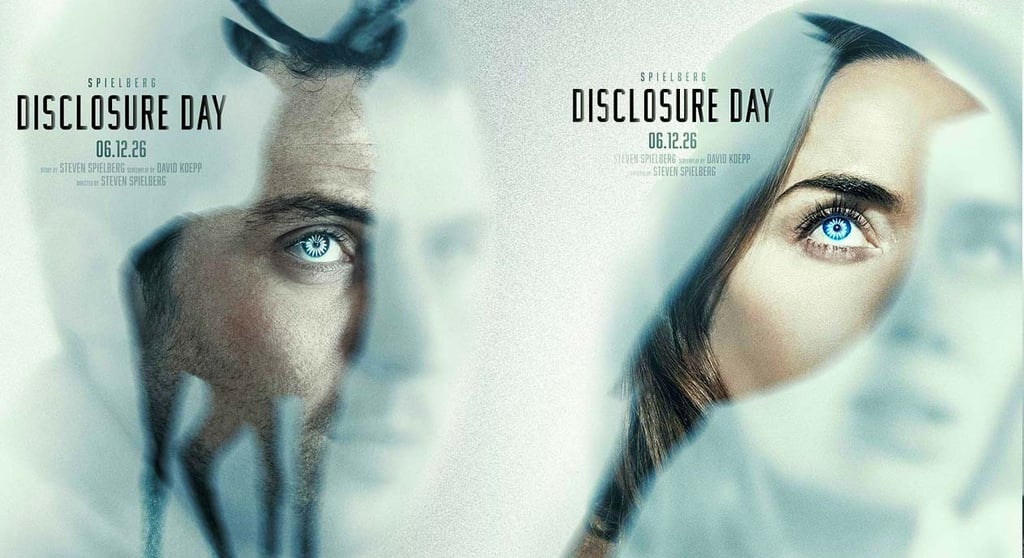
The Spielberg "Disclosure" Phenomenon: Cinema or Secret Reality?
Steven Spielberg has spent a career bridging the gap between the stars and our living rooms. From the benevolent visitors of Close Encounters of the Third Kind to the heartbreaking wonder of E.T., he has shaped the way the world envisions life beyond Earth. However, his latest project, ***Disclosure Day***, has triggered a reaction unlike anything seen in his previous work. Since the release of the first trailer, social media platforms have been engulfed by a wave of speculation that blurs the line between high-budget marketing and high-level government whistleblowing.
The Trailer That Broke the Internet
The promotional clip for Disclosure Day is a masterclass in psychological tension. Rather than showing silver spaceships or little green men, it focuses on the uncanny and the systemic. The footage is a jarring montage: a news anchor’s voice dissolving into static mid-sentence, everyday citizens appearing to visually "stutter" or glitch, and a silent cardinal watching over a chaotic scene like an ancient sentinel.
The emotional anchor of the teaser is a frantic voiceover declaring, "It belongs to seven billion people," a line that has become a rallying cry for online theorists. Within hours of the trailer’s debut, "Disclosure Day" began trending globally. On platforms like X (formerly Twitter) and Reddit, a familiar cycle began: what started as film analysis quickly spiraled into "evidence gathering," with users claiming the film is a thinly veiled message about the true nature of our reality.
Deep Dive: The Core Conspiracy Theories
Why has this specific film ignited such a firestorm? To understand the reaction, one must look at the specific "UFO lore" tropes that Spielberg and writer David Koepp have woven into the narrative fabric.
1. The "Soft Disclosure" and Cultural Priming Narrative
A prominent theory among fringe communities is that the U.S. government uses Hollywood to "socialize" the public to the idea of alien life. The logic suggests that by presenting extraterrestrials in a cinematic context first, the eventual real-world announcement will cause less societal collapse. Theorists argue that Spielberg—a man with alleged ties to the highest levels of the establishment—is the perfect vessel for this "cultural priming." To these observers, Disclosure Day isn't just a sci-fi thriller; it’s an orientation video for the human race.
2. The Animal "Hive Mind" Theory
One of the most artistic elements of the trailer—the focus on birds, deer, and other wildlife—has sparked a unique brand of speculation. Some viewers believe the film suggests that non-human animals are already part of an interconnected alien intelligence or "hive mind." This taps into older myths and modern "woo" science, suggesting that human senses are too limited to perceive the intelligence networks already integrated into the natural world. In this view, the "glitching" humans in the trailer are those who are finally starting to see the "program" running in the background.
3. Reverse Engineering and Hidden Secrets
The "seven billion people" line directly feeds into the "Disclosure Movement," a real-world group of activists and former military officials who believe that alien technology has been recovered and reverse-engineered in secret. The theory suggests that the "truth" being hidden is not just that aliens exist, but that their technology—which could solve energy and climate crises—is being hoarded by a shadowy cabal.
Fact-Checking the Frenzy
While the internet continues to "connect the dots," the reality of the production is far more traditional.
* The Cast and Crew:
The film is a prestige Hollywood production. It features a powerhouse cast including Emily Blunt, Josh O'Connor, and Colin Firth. It is written by David Koepp, the scribe behind Jurassic Park, a writer known for grounded, human-centric takes on extraordinary events.
* The Timeline:
Universal Pictures has scheduled the film for a wide theatrical release on June 12, 2026. This long lead time is typical for a major summer blockbuster that involves extensive visual effects.
* Cinematic Language: The "glitching" faces and eerie animal behavior are classic tropes of the "techno-horror" and "cosmic horror" genres. They serve a clear narrative purpose: to create a sense of global unease and to suggest that the "threat" in the movie is something that bypasses traditional human perception.
Why We Want to Believe
The success of the Disclosure Day trailer lies in its timing. We are living in an era where the U.S. Congress has held actual hearings on "Unidentified Anomalous Phenomena" (UAPs) and where documentaries like The Age of Disclosure have moved UFO talk from the tabloids to the mainstream.
Spielberg is not necessarily "telling the truth" about secret alien life; rather, he is a genius at reflecting our current cultural anxieties back at us. In a world of deepfakes, AI, and concerns about government transparency, the idea that "something is out there" and "someone is hiding it" feels more plausible than ever to a modern audience.
Ultimately, Disclosure Day appears to be exactly what Spielberg does best: a high-stakes, beautifully shot piece of fiction that makes us look at the sky—and each other—with a little more suspicion and a lot more wonder.